Posted in Life Journey

How your behaviors affect others

Being self-aware is crucial in emotional intelligence.  I am a strong believer that being unaware leaves you open and vulnerable to negative encounters both personally and professionally.  Therefore, it is vital to be fully self-aware, and even “in the moment” in order to encourage positive encounters.

True to form, being self-aware also creates positive encounters for others. If you are aware of your own behaviors and manage yourself effectively, you are going to produce positive results with others, even if it’s unintentional.

One of my favorite bloggers and leaders in business and leadership, Michael Hyatt, talks about encouraging and energizing your team here, where he discusses being intentional with your team.  However, his main points also resonate with in the context of personal awareness and how it affects others.

If you can intentionally move through life with these thoughts in a general context, you will ultimately affect others in a positive manner. Let’s take a look at his five points in a general way and see how being self-aware can ultimately affect others.

  1. Assume others are smart and hard-working.   No matter who you encounter, most likely there is someone else who is working just as hard as you.  There will always be someone who works harder, is smarter, is prettier, is funnier, is wealthier….the list goes on and on.  To assume otherwise is only making yourself seem less intelligent and less astute.  Always assume the best in every situation.
  2. Listen intently and ask thoughtful questions.  Listening is the key to success.  I am in sales, and anyone NOT in sales assumes that being able to give an effective presentation and talk fluently about a service or product will lead to sales success.  Truth is that asking questions and actively listening (as opposed to planning your next statement) will lead to more success.  In the same respect, listening intently and asking thoughtful questions also leads to positive encounters, as it creates in the other person feelings of importance and validation. This is one of the single most valuable things you can do for another person.
  3. Acknowledge the sacrifices others have made on your behalf.  Think about this for a moment…how many times throughout a day do people sacrifice on your behalf?  Someone let’s you go first at the four-way stop, someone let’s you go ahead of them in the grocery store or the local Starbucks, someone picks up the money that fell out of your back pocket or runs out to return the cell phone you left on the table in McDonald’s.  Every day we encounter sacrifices, and also offer sacrifices, even in the smallest of forms.  Are you aware of them?  Do you acknowledge these small acts of kindness for what they are – sacrifice?
  4. Express gratitude for their effort and their results.  Being grateful and showing appreciation to others who have sacrificed, offered time and effort to create something great, is largely a testament to the person you are, and it shows a person of integrity and ethical standards.  Doing this on a small scale, even to strangers, shows that you are aware of the situations that provide opportunities as they present themselves.
  5. Remind them why their work is so important and the difference they are making.  Being in a position to acknowledge sacrifice and show gratitude are small gestures that express the importance of an action.  Being able to effectively influence others with a simple statement of value not only signifies that you are self-aware and in the moment, but it can have a very profound affect on the other person involved.  How many times have you smiled because someone thanked you for something you do every day?  Think about the feeling of importance when someone saying thank you for holding the door. It may have been a small gesture you provided, but a thank you and smile let you know that, even for just a moment, you helped someone; you made a difference.

It is evident that we have the ability to affect others in our every day encounters.  Most people move through life without paying attention to the details that surround them.  Being intentional with your actions, being intentionally self-aware, and paying attention to the details in life will get you results, but it will also allow you to see life through different lenses.  You will notice the glass is half full when you continue to fill it with positive actions.

I challenge you to continue your journey into self-awareness. Realize the impact you have on others simply because you are more self-aware today.  You are making difference, even if you don’t know it.
 

Posted in Life Journey

A glance into my E.I. journey

My background is human resources and organizational behavior, and my interests revolve around training and development, organizational dynamics, and culture, but my passion lies in how relationships affect all of these areas; how attitude, beliefs, awareness, body language, word choices, and the like affect our ability to be driven, to be productive, to be successful.  And like most, my own life experiences fueled my passion for learning more about what is known today as emotional intelligence.

I followed a fairly standard path – high school, college, job, marriage, children.  And then I woke up one day and felt really uneasy about where I was in life.  At 23, I was a wife and mother.  I was still working two jobs trying to make ends meet and feverishly applying for jobs in my field of Human Resources with no prospects in site while my friends, both high school and college, were digging into careers and just beginning to narrow down the dating pool.  Though I kept in touch with a lot of people, I slowly felt like my friends had no idea what my life was like.  We were in different places, and we couldn’t really relate anymore.  My husband at the time was a restaurant manager with crazy hours.  I spent a lot of time at home alone with the tiny creature of a child.  I worked in childcare for eight years; I knew what to do with him.  But at the same time, I had no idea what to do with him!  When the then-husband was home, he spent a lot of time unwinding with a bottle of wine –  or 3 – and he didn’t really engage in the marriage.  There wasn’t a lot of help around the house, and there wasn’t a lot of positive communications happening.   I felt more like a single mom raising two children (one being my ex-husband) then I did a married woman.  And I found myself at 24 questioning so many aspects of my life.  I followed “the rules” and did what I supposed to do, so why was I so unhappy?  How had I gotten so far off course??

I don’t know if there was specific moment in which I had an epiphany, but more that it was a steady buildup of frustrations.  The details of the situations are for another time, but I sat on the floor next to my son’s bed, sad for him that he was in the middle of such a bad place.  I rubbed his little head, and there was a point of absolute clarity.  There was a certain kind of peace in that clarity, in knowing that the problems I was trying so desperately to fix were not my burden to bear.  They were bigger than me, and definitely bigger than my marriage, and in that moment I knew that I couldn’t stay.  I didn’t need a husband.  I couldn’t fix him.  But my son did need a father, and he couldn’t stay in the marriage and become the person he needed to become in order to be the father our son needed.  I packed a bag, picked up my son in the middle of the night, and headed for the door.  I don’t claim to be perfect, nor have I ever said I had no fault in the end, but for myself and my son, I decided to walk away and not look back.  So at 26, I was a divorced, single mom, finishing a master’s degree, working two jobs and living on my sister.

That moment of clarity is the beginning of my journey into and through emotional intelligence.  It was the start of realizing that I am stronger than I think I am most of the time.  It was the beginning of soul-searching, of really focusing on what I needed in my life and a lot of narrowing down what I didn’t need and removing it entirely. It was the emotional struggle of divorce and all that comes with it. It was dating a few more frogs before finding my prince of a man who would become my king.  And through the whole process I was able to start compartmentalizing the different areas of my past in such a way that I started to understand how my past shaped who I was and why I reacted so strongly on the emotional side to situations.  I started to learn triggers and how to manipulate my mind to work through those triggers in order to stay grounded and logical.  It was gaining a clear understanding of how my mind and emotions work together to form thoughts, opinions, and reactions.

They say time heals all things.  I’m not sure that I ever fully recovered and went back to the person I was.  I’m not sure anyone can go back after such hurtful times.  But I do believe that I needed those times to grow.  I needed to work through the anger and frustration I felt after my divorce.  I needed to work through my feelings of abandonment and failure.  I needed to work through the depression, the suffering, and the sadness.  I am still a work in progress, but I am much stronger today than I ever have been before.  And I know that it is because I worked towards being more self-aware in order to become the person I was meant to be.

Self-awareness is the first step towards emotional intelligence, followed closely by self-management.  Both of these steps gets overlooked a lot of times, mostly because the vast majority feel that they “know themselves well enough”.  But I would argue that most people probably do NOT know themselves as well as they think.  Or they are very self-aware but do poorly with the management aspect.  If I could urge you in any direction for emotional intelligence, starting today, it would be to pay attention.  Pay attention to the signs your subconscious is putting in front of you.  Pay attention to your emotional being throughout the day, week, month.  Pay attention to how your surroundings play into those emotions.  Is it raining out? Who are you around when you feel certain ways?  Did you eat breakfast today?  How do these things affect you emotionally?  What happened right before your last argument?  What was the topic? Was it really anger that fueled it, or was it more likely due to fear or lack of control?

Start this process.  Do it diligently and for an extended period of time.  I started these thoughts at the age of 24. I will be 36 this year, and I’m still working through becoming more self-aware.  It is not a destination, but the true form of a life journey.  Change is a definite guarantee in life, and with change comes emotional instability and the opportunity to learn something new about yourself.  Take advantage of those opportunities.  Most importantly, be open to the learning curve and enjoy what it will bring your way.

Posted in Life Journey

Emotional Intelligence at a glance

Emotional intelligence (EI) is quickly gaining momentum throughout the business world, as many companies are turning to EI for hiring and promoting.  It is the foundation of good relationships, and relationships are what keep a company floating.  Loyalty, trust, reputation – all founded on the principles employed in EI.  So with something holding such an integral part of business, why wouldn’t want to be more in tune?

Whether you are aware of it or not, emotional intelligence is running 80-85% of your daily interactions.  It is the essence of every conversation you start and end in your personal and professional life.  Granted, some may take more effort.  I personally spend more time calculating my conversation with the CEO that will be present at my next presentation than I do with my 3-year-old, but the relationship piece is eminent just the same.  With that in mind, it’s important to understand the various elements of emotional intelligence and to start having a keen understanding of where we fall in each category.

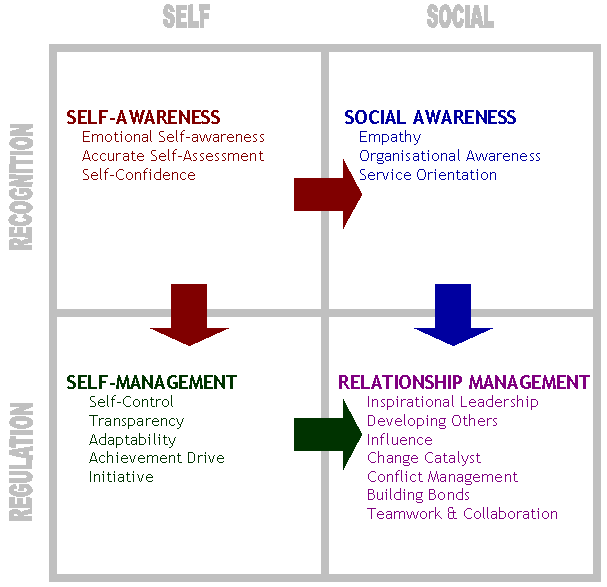
Put simply, there are two categories of emotional intelligence:  Self-awareness and social awareness.  And these two categories are each broken down into two sections of knowing and managing.  This leads to the graph below and the most widely recognize definition of emotional intelligence:  the ability to know, understand and manage one’s own emotions and the ability to know, understand and manage the emotions of others in order to produce a desired result or outcome.


EI

Let’s take a look at these areas one by one.

Self-Awareness.  Knowing yourself is the cornerstone of EI.  If you do not have a keen awareness of your own emotional state, and more so an understanding of why you are in the state, then moving into other areas of EI is almost impossible.  When you find yourself in a position of being overly emotional (frustration, stress, anger, upset, agitated), start focusing on the triggers that led to this state.

Self-Management.  Once you know yourself, you are more likely to be able to control your emotional state, especially under pressure.  This is vitally important for managers and anyone in sales where handling high stress is a frequent occurrence.  As you start recognizing the triggers, the ability to begin controlling, managing, and even changing that emotional state becomes easier, or you will be able to regulate the emotions and force logic into the equation to manage your emotional state more effectively.

Social Awareness.  Once there is a keen understanding of emotional aptitude, the ability to begin recognizing emotions and triggers in others will become easier.  Social awareness is recognition of an emotional exchange during an interaction.  Conversations will begin to take shape in an emotional context, and seeing different emotional states in yourself and others during the conversation will help to guide or even end the conversation.

Social Management.  The final stage of EI is handling the emotions in social settings, whether professional or personal, in order to produce a desired result.  A salesperson will use emotional context throughout a sales process to move forward in the negotiation and guide the buyer towards a decision.  A boyfriend may use the emotional awareness of his girlfriend during a proposal.  Being socially aware and managing social awareness is the highest level of emotional intelligence, and it is the most difficult in which to gain proficiency, but with practice it can be done.

So as we move forward, I challenge you to begin noticing emotional contexts throughout your conversations and interactions.  As you start noticing, start toying with your own emotional state and see how it affects others.  You might just be surprised at what you start to encounter.

Posted in Life Journey

Pageants, Running and Life

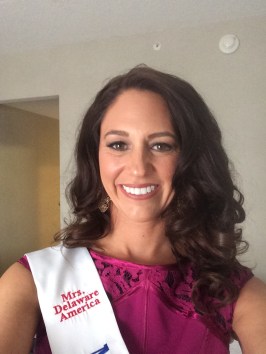
This past weekend, I had the privilege of representing my small hometown of Pike Creek, Delaware in the Mrs. Delaware America pageant.  I finished 1st Runner up to the new Mrs. Delaware America 2016, which is an accomplishment in itself.  In my experiences, the Mrs. PageantIMG_2477s bring some of the most intelligent and accomplished women to the forefront. I know it sounds superficial, and maybe even a little cliché, but there is a lot to learn from pageantry.  Here is what I took away this weekend, and the lessons I can use in life:

  1. Make-up and hair may seem insignificant, but the final package would be incomplete without the small details. Being on stage under bright lights can bring out every flaw, so the final touches and small details of make-up and hair really make a difference in how you appear.  Life is a stage also, and while the small details may seem insignificant, it can have a huge impact on how you are perceived as a professional and as a person.  Pay attention to the details that others find insignificant.  You will be remembered for them some day.
  2. Beauty runs so much deeper than the skin. While we are all on a mission to win, we still took time to chat, get to know each other a little better, and really connect.  By doing so, we not only left with a feeling of accomplishment for being on stage (I mean, it takes guts to be in a swimsuit and be judged), but we also left with new friends, friends that will be supportive of all of our future endeavors, both pageant related and in our daily lives. Beauty is found in how you treat others and how you make them feel, not in how you look. If you miss out on the chance to get to know someone, even just a little, than you miss the entire point of life.  This is where my emotional intelligence passions kick in, because so many of us miss opportunities to make connections with people who are right in front of us because we are future focused.  Having goals for the future is good, but never miss the opportunity to live in the moment.
  3. Pageant heels have a way of making you feel like a powerful woman! You do feel powerful and feminine when wearing a good pair of heels!  But man, do they hurt!!  Heels are just an obstacle to the presentation, and as a pageant contestant, you walk through the pain with a smile on your face, graceful and poised.  In life, we come across obstacles all the time.  We just have to keep moving through the struggles.  Eventually, you get to a point where the pain becomes less, and the success becomes worth so much more.
  4. Women really can run the world! The women in my small state are phenomenal women with education and careers that will rival any man. We own our own businesses, are doctors in our fields, work in government with high profile community leaders.  We are advocates for worthy causes, and take a stand for what we believe is right by getting in front of people, not just making a blanket statement on facebook or twitter. We are women who WILL make a difference in this world, WITH or WITHOUT a title and crown.  So watch out world, these Delaware women are on a mission!!

Every woman has a different take on the experience of pageantry.  I have different lessons I have taken from each experience, some negative, but most are positive.  I am now on the other side of pageants as a choreographer and judge, and being on the stage or behind the stage takes me out of my comfort zone and challenges me.


Running is another challenge for me.  I have had a love-hate relationship with running for as long as I can remember.  Most people say they can get lost in thought when running, but me?  All I can think about is my heavy breathing, my cement legs, and my feet hitting the pavement.

I have a friend who is an avid runner, and she challenged me to run with her.  I know it has its health benefits, and as I was preparing for a pageant, I thought the running would be beneficial.  I agreed back in October to run in the Blue Cross Broad Street 10 miler.  The thought process was that it was October, and I had plenty of time to train to get to 10 miles. Fast forward to April 1st, and I’m still at 2 miles with not a whole lot of progress.  I pushed myself, and was able to get to 6 miles one week before the race.  What I also figured out one week before the race was that I was going to be in heels for two days prior to race day.  What was I thinking????  But challenges motivate me, and so I pushed on.  Here is what I learned on race day from my first distance run:

  1. Running in the rain doesn’t have to slow you down.  When I agreed to this race, my friend (the avid marathon runner) assured me that this was “the best run ever”.  She said the weather is always beautiful, and you’re going to love it! But at 4:47am when I got out of bed on race day, it was pouring down rain.  I suddenly was rushing to figure out a different outfit, knowing that I don’t necessarily enjoy running in the rain, and that the temperature had dropped dramatically throughout the night, the shorts and tank were not going to due.  I grabbed my capri pants with the pocket (for my phone) and a long sleeve shirt on my way out the door.  It was wet.  It was cold.  I walked around with a pine-scented trash bag on my head, and my feet were drenched before I even got to the starting line.  But when the horn sounded and 50,000 runners began the 10 mile trek, it was on.  I finally found my groove, and it was exhilarating!  Life will always through you lemons, so grab your juicer and some sugar and be prepared to host a lemonade stand!
  2. Your body is capable of more than you think, and our minds control the thinking.  There were times when I wanted to stop, but I didn’t.  I tried to talk myself into to resting or walking, but I didn’t.  I was determined to prove to myself that I was capable.  I kept a positive thought flow through the run, and pushed myself past the limits I thought I had.  I not only finished without stopping or walking, but I also finished within my goal of 2 hours.  I had a time of 1:59:27.  Who says I can’t do it?  Not this woman!!  I can do anything I put my mind to, and so can you!  The mind is a powerful tool; how are you using yours?
  3. And I thought heels were bad!?!  I spent two days in heels when I’m usually in sneakers, so I started the race a little behind the eight ball.  The heels the night before did a number on my leg muscles.  By mile 4 my quads were telling me they were tired.  By mile 7 my calves were screaming at me!  I grabbed water and gatorade, and decided that if I stopped I wouldn’t start again, so I kept going.  It’s the Monday after pageant weekend and the day after race day, and my legs are NOT happy with me today.  But it would have been worse to have stopped or quit.  This pain will go away, but quitting would have been a regret.  In life, when things get tough, we are give the choice to quit or the choice to keep going.  The choices we make will determine the results you get, and how quickly.  Nothing worthwhile is easily accomplished. So keep training, keep working, keep going.  You’ll get there, my friend!


We learn and grow when we step out of comfort zone, and we move forward having found strengths we did not realize were in us. Success is found in a lot of places, but you have to know yourself before being successful; pageants and running are just two places to find yourself.